30 May 2004 :: Building a Life-Size R2-D2
Dedicated fan, or crazy person. It's a fine line, they say. You've probably crossed the line when the number of life-size robots and assorted villains outnumber the human inhabitants of your house. Ah well, I guess I am progressing from "crazy" to "very crazy" as I start my latest project: a life-size, aluminium R2-D2.
This is an ambitious project I have been intent on undertaking for a couple of years now. And recently, I finally got around to taking hacksaw and power-tools to metal in pursuit of my own life-size astromech. I take comfort in the fact that there are many others out there similarly obsessed...indeed, a couple of online groups (see links at the end of this article) actively facilitate collaboration for the sake of planning and production of parts. Standardised plans available through the hard work of such groups (that average out the difference in all of the many Artoo units used in filming) mean that dimensions can be used, or taken to a engineering shop to have parts machined, in such a way that all individual compenents will fit together with excellent tolerances.
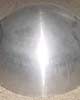
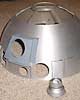
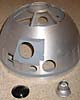
I have chosen to start with the dome. This would be one of the hardest parts to tackle by hand, so, with the help of some acquaintances using similar methods, I am basing mine on a double-layered, laser-cut aluminium dome engineered overseas (kudos to Ron and Jason of 'R&J Superdome' fame). Artoo's dome, despite initial appearances, isn't a hemisphere, but rather has one axis longer than the other. This makes the paths a cutting laser must trace quite involved to compute and execute...a 5-axis computer-controlled laser is required, and none capable of completing the task were available in New Zealand.
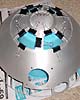
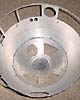
The idea behind a 2-layered dome is that an internal layer, which does not need to be complete, supports the panels of the external layer. You'll start to see how that comes together in a follow-up article, but clicking on the thumbnails above (fourth and fifth images) will show the apical portion being glued in place. The panels and holes for details have been cut, by laser, in the outer dome, but need to be cut manually, using a high-speed rotary tool (I use a Dremel) and a lot of cutting discs.
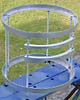
A similar 2-layered approach is used for the body 'skins', for the same reason. Beneath the skin, some sort of a supporting frame is required - the sixth image above shows the initial steps in the skeleton construction. ..the critical step here is ensuring that all rings and partial rings are 100% parallel, otherwise the skins won't align properly, and all subsequent construction will be off.
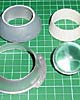
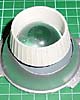
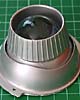
Because the epoxy glue used takes 24 hours to cure (I am also using a rapid-set version for smaller parts, but for the major dome and body work, I need the bullet-proof stuff), I have started on a few of the detail parts in parallel. Some of you will know that the 3 holoprojectors on an astromech dome are actually reading lamps from a Vickers Viscount 700 aircraft. The real items are in short supply, but fortunately, a number of very passable replica versions are available. The thumbnails above link to progress shots of modified cast resin replica using an acrylic sphere for the lens. I am going to use such resin pieces for the top and rear holoprojectors, but am looking forward to shortly receiving an expertly machined and very accurate aluminium copy that will be used for R2's front holoprojector, and will include lighting effects.
And the final simultaneous thread in this project is the painting. I am starting with all the blue components (and a couple of replica pieces that are metallic aluminium in colour). Each panel or detail piece needs to be filed, sanded and then receives up to 9 or 10 coats (3 or 4 each of aluminium etching primer, base coat and pearlescent lacquer) in order to achieve the desired finish. That will be the topic of the next installment...
Next page: Part Two, Artoo Blue.
Related article: Collector Spotlight - Matt G
Related link: R2Builders - Artoo-Detoo Builders Club at Yahoo! Groups.
Related link: Astromechs - Astromech Droid Builders Club at Yahoo! Groups.
Matt G